
November 10, 2022
Narration
The soldiers had brought a group of prisoners from Russia to Drange. There were 33 prisoners.
A fence went up right in Bjorg’s yard, by the stream, that would contain all of the prisoners.
Bessa: I remember when they started putting up that barbed wire fence and it was tall. It was, it had to be at least six feet tall because they couldn’t jump over. And if they tried to climb over it, they would get really hurt because on top, it was all those, those things, you know. So, they couldn’t get over.
It took them a long time to put that fence up. It was a big area. So they had a place to roam, you know? And they were starving.
Kristen: How did you know they were Russian?
Bessa: We just knew. I guess we were told. They didn’t speak Norwegian, they didn’t speak German. They were shaved. Their heads were shaved.
Kristen: Was it all men?
Bessa: Yes, all men.
Kristen: What did they wear?
Bessa: Just ordinary, not nice clothes.
Kristen: Did they have a private place to go to the bathroom?
Bessa: They used – and it’s still standing – the outhouse for the preaching house – that was the bathroom. They had no showers. There was nothing. I don’t know where they washed, unless they did that in the river.
Kristen: Where did they sleep?
Bessa: On the floor in the preaching house.
Kristen: I thought they were in the fence.
Bessa: At night, they didn’t sleep outside. At night, they slept on the floors. They couldn’t sleep outside. In the wintertime they would have froze to death.
Narration
One day, there was one prisoner Bjorg saw when she was near the fence, and he signaled to her that he needed food.
Bessa: Somehow he let me know that he was hungry. He must have asked me for food. Of course they were hungry, those poor guys.
Bessa: And we were not allowed to – we knew we were not allowed to feed or to give them any kind of food.
Narration
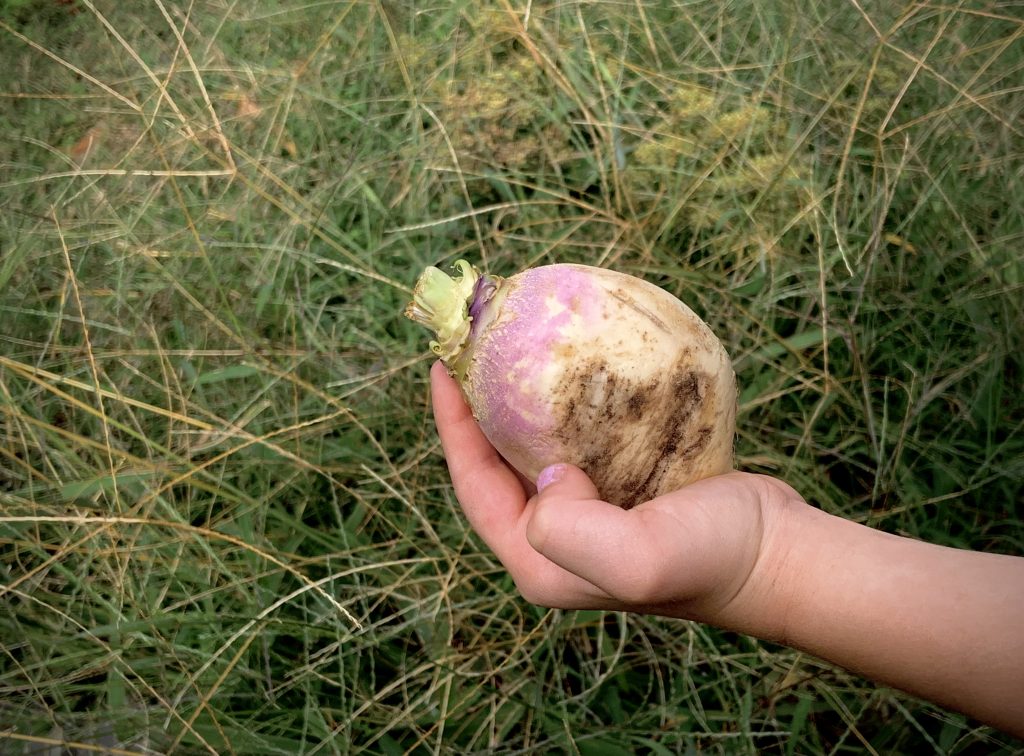
My grandmother told me that the soldiers would take the turnips her family grew on the farm for themselves.
Bessa: One time I found one that they missed, and I snuck that in to the prisoner. And I didn’t know, but the soldier saw me. He must have been pretty close, because he was right there. I got hit in the shoulder with the rifle – the handle of the rifle. It hurt. HE spoke to me in German, and I understood German in those days, perfect. I can still feel that in my shoulder. He said to me if I ever see you do that again, Next time, I’ll kill you.
And they would. And they took the turnip away from from there.
I didn’t even tell Mama that. She would have been mad at me.
Narration
Bjorg’s compassion to this prisoner – is really profound.
She really felt for the prisoners. They were all living a terrible reality.
Maybe one way that my grandmother got through these circumstances was thinking about the ones who had it really bad. In this moment, she focused on making things better for someone else.
A note about the prisoners: My grandmother said that the Russians were being held prisoner by the Germans because if Germany had won the war, they would have kept them to do work for them. She said there were other groups of prisoners from Russia held in other parts of Norway by the Nazis as well.
You’ll get to hear about another way that Bjorg and her friends played their part in resisting the war, next week. It’s a good one.
I’m your host Kristen and I also produce and write this podcast.
I would like to thank Iris for posing with the turnip! Thanks for lending a hand. You all can find the photo on our social media and on Bessastory.com.
And thank you of course to our sound engineer Kalyn Pedde who helps me with getting the sound right for this show and listens to each episode. It is so helpful. Thank you.
Please subscribe to this show on iTunes! While you are there, would you please leave a rating and a comment? I would love to hear what you think.
Loved this episode too. It’s hard to imagine the very place where you and Eva used to play held starving young men.
You have a great audio voice which lulls you into the story.
Love Mom.